


Smart home: Internet technologies for modern life
to read 6 min
- Why is a smart home the future of modern life?
- What is Home Assistant and how does it work?
- How exactly does the home system work?
- Quality Internet for a smart home: why is it important?
- What kind of Internet is better to connect?
- Benefits of home automation with Home Assistant
- Checklist: how to ensure stable operation of a smart home?
Why is a smart home the future of modern life?
A smart home uses modern technologies for full automation. It can do everything on its own, even without your assistance. You just need to set up certain scripts that will be repeated day after day.
What does it need? Reliable equipment, modern automation, and, of course, high-quality fiber optic internet. Technologies such as GPON allow you to provide connectivity that becomes the basis for the operation of absolutely all systems.
Just remember, just a few years ago, the idea of a house that independently regulates lighting, maintains a comfortable temperature, or reminds you to turn off appliances seemed like a fantasy. Today, it is a reality that is available to everyone. A smart home is about convenience, savings, and security.
For example, imagine that you forgot to turn off the lights in the hallway, but they did it for you as soon as you left. Or, a few minutes before you returned home, your smart home turned on the lights, heated the room, played music, and heated the kettle for you. Interestingly, the popularity of such systems has grown significantly in recent years. Today, they are installed not only in large houses but also in ordinary apartments.
For all this to work smoothly, it is important to choose a tariff and connect fiber optic Internet and choose the right platform to manage all devices. For example, GPON technology provides not only high speed, but also energy independence and stability, which is so important for all devices in the house.
And one of the best solutions among home automation systems is Home Assistant, a system that can combine different elements of your home into a single whole.
It is simply amazing in its versatility. The platform allows you to customize automation to your personal needs: from lighting control to security system integration. Moreover, Home Assistant works locally, so you don't have to worry about data security.
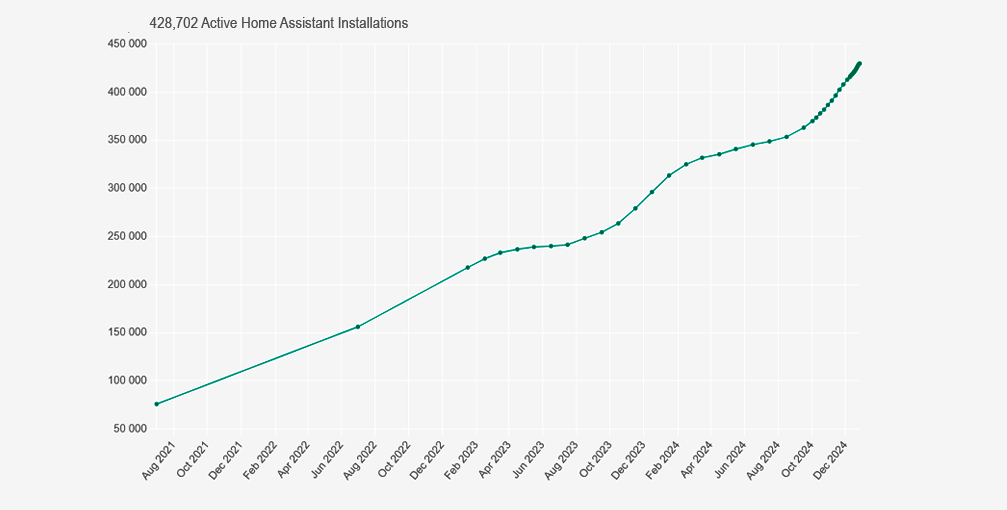
The facts speak for themselves: by 2024, more than 70% of users worldwide are actively interested in smart home technologies. Moreover, the popularity of Home Assistant continues to grow worldwide, and as of December 2024, the number of active installations has already exceeded 419 thousand. And the optical Internet connection with GPON technology provides a 99.9% guarantee of stability.
Statistics on Home Assistant app downloads from 2021 to 2024.
So, today, investing in a smart home and high-quality home Internet means comfort and confidence in the future.
What is Home Assistant and how does it work?

Home Assistant is a platform that has become a real godsend for those who want to create their own smart home. The story began in 2013 when Dutch developer Paul Schouten decided to create a universal solution for home automation. Initially, it was a small open source project, and later, thanks to support from the community, it became one of the most popular home automation systems.
The main principles of Home Assistant are local integration and a single ecosystem. All data is stored and processed through a single platform that runs locally on your server (for example, a Raspberry Pi or computer). This ensures speed, stability, and full control over the entire system. In addition, this solution guarantees the security of your data.
How exactly does the home system work?

Connecting devices: Each device (sensor, lamp, thermostat, camera) has its own protocol for connecting, such as Wi-Fi, Zigbee, or Z-Wave. Home Assistant can work with many different standards and allows devices from different manufacturers to “communicate” with each other. They will all connect to your local server, and as a result, interact.
-
Data processing: All data from devices is collected on your server. For example, sensors send information about the temperature in the room, and cameras send information about movement.
-
Automation: The most interesting part is the automation. Home Assistant not only collects data but also automatically performs certain actions. If the motion sensor detects that someone has entered the room, the system can turn on the lights. You can customize all of this yourself, how you want your home to react to different situations.
- Management and integration: All of this can be controlled through a mobile app or web interface. After setting up devices and automation, you can receive notifications (for example, if the temperature gets too high or if someone enters your home). Since Home Assistant works locally, it doesn't require constant access to the network, although for remote access and updates, of course, you will need a high-quality Internet connection for your home.
Quality Internet for a smart home: why is it important?
An Internet connection is the basis without which a smart home simply cannot operate at full capacity. For all devices, sensors, and other home automation to work smoothly and without delays, you need a reliable optical Internet connection:
-
Smooth operation of devices. In a smart home, dozens of devices are constantly exchanging data: motion sensors, thermostats, cameras, or smart sockets. This requires a home Internet connection, and if it is unstable, the entire automation of your home will be destroyed.
-
Remote control. The key advantage is the ability to control from anywhere in the world. You can turn on the heating, check security cameras, and much more. All you need is a fast and stable internet connection.
- System scalability. Over time, you may want to expand your smart home and add even more new devices to the system. But the more there are, the higher the requirements for Internet speed (especially when it comes to the simultaneous operation of all gadgets). So it's also important to choose the right tariff plan.
What kind of Internet is better to connect?
Today, many people choose fiber-optic Internet and GPON technology from the BRIZ Internet provider. This is a guarantee of real speed and reliability, especially the operation of your network without electricity. For smart homes with a large number of connected devices, this is a real salvation.
BRIZ offers high-speed Internet connection with fiber optics in Odesa and Odesa region at a price of 300 UAH per month.
Benefits of home automation with Home Assistant
-
Comfort. Home Assistant takes care of routine tasks, you don't need to do it manually - the system will do everything for you.
-
Savings. The system will help reduce costs by turning off the heating, air conditioning, or lights when no one is home. This is convenient and allows you to save on utilities.
-
Work in a local network. Everything will work without the need for constant access to the Internet. This allows you to control devices even in the event of a connection failure, ensuring the stable operation of your smart home.
-
Privacy. Unlike many other platforms, Home Assistant stores all data locally. You can fully control all your information without worrying about security and privacy.
-
Wide device support. Home Assistant supports thousands of gadgets and standards, including Wi-Fi, Zigbee, Z-Wave, and others. Thanks to this, you can easily connect any device, regardless of the manufacturer.
- Simple to use. The service interface is intuitive, and there is also a mobile app that allows you to easily manage all devices and create automation scenarios right from your smartphone.
Checklist: how to ensure stable operation of a smart home?
It is important to remember that several key factors need to be taken into account for successful automation and stable operation of the system. Choosing the right equipment, a stable fiber optic internet connection, setting up backup power supplies, and timely system updates all contribute to the smooth operation of your smart home.
Here's a simple checklist to keep your smart home running efficiently:
-
Choose a reliable internet provider. Your smart home needs a fast and reliable connection to work efficiently. BRIZ offers fiber-optic Internet in Odesa and the region with a guarantee of speed and blackout operation, which is just perfect for stable operation of systems.
-
Interface settings. Most often, single-board computers are used for Home Assistant. This is a compact and efficient solution for launching your home automation system, but by and large, any PC with standard requirements will do.
-
Smart devices. For the system to work effectively, you will need automation devices such as thermostats, cameras, or motion sensors. For integration, they must be compatible with your system.
-
Network interface. To connect devices, it is important to have a high-quality router that will provide connectivity between all gadgets.
-
Choose the right tariff plan. When setting up a smart home, it is important to have a tariff with sufficient speed for the constant operation of all devices.
- Use a backup power supply. Install a UPS to avoid internet and important device outages.
Now you know how to start your journey into the world of automation! It's time to take action and make your home smart and livable.
Receive information about promotions and news from BRIZ to your email address

Be the first to comment