


Fiber optic cable vs. Twisted pair
to read 7 min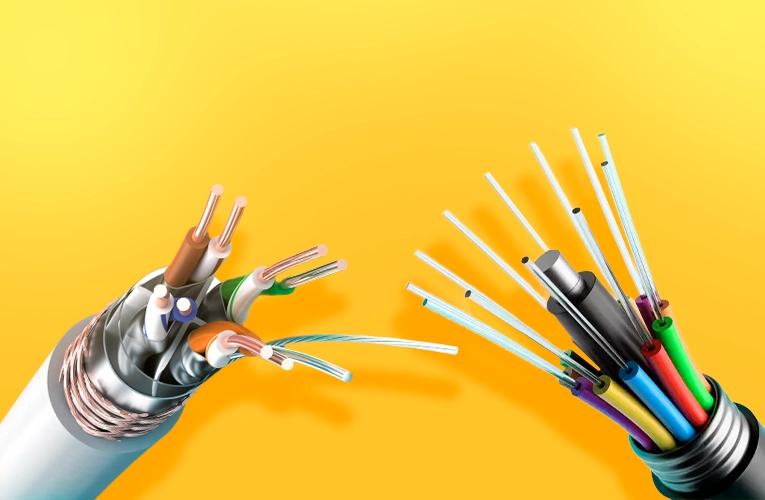
Have you ever wondered how the Internet gets to your home? Obviously, it's connected by cables, but do you know what kind they are? There are two main types: twisted pair and fiber optic. At first sight, they look similar, but there is a big difference between them.
Fiber optics are generally a more expensive solution, while copper cable is much more common, but why is that? Which is better, fiber or twisted pair? The advantages and disadvantages and everything you need to know about these cables to understand the difference.
Twisted pair is a copper cable in which the conductors are twisted in pairs. Depending on the type of cable, it can transmit data at speeds of up to 100 or 1000 Mbps.
Fiber optics are a completely different story. It is an ultra-thin glass thread that transmits information in the form of light pulses. In other words, the data literally “flies” at the speed of light.
Let's take a closer look at it.
Twisted pair
Twisted pair cable was created by Alexander Bell in 1881 and was used in US telephone lines until 1900. It consists of several pairs of insulated copper wires twisted together. Twisting the wires helps to reduce electromagnetic interference and crosstalk between the pairs, providing better data transmission of electrical signals.
In addition, the cable itself can have additional layers to protect against external interference and vary in data transmission speed.
Advantages of twisted pair:
- Flexibility: Due to its flexibility, twisted pair can easily be adapted to any installation conditions and remain efficient.
- Installation and repair: The cable is easy to maintain, you can easily learn how to make twists, crimp the cable, which greatly simplifies its independent installation and servicing.
Disadvantages of the cable:
- Interference: Twisted pair is particularly sensitive to electromagnetic waves, which can cause deterioration and loss of communication. Also, over time, the cable can degrade, as copper has a property called oxidation.
- Data transmission range: The cable has a limited transmission distance (up to 100 meters), which does not allow it to be used in large networks.
Optical fiber
Optical fiber was created by Charles Kao in 1966 and has been actively used to transmit data over long distances since the end of the 20th century. It consists of thin fibers made of glass or plastic through which data is transmitted in the form of light signals. This transmission method makes it possible to achieve high speeds and long distances without significant signal loss.
Advantages:
- Speed: Fiber optic cable has a high bandwidth, making it optimal for data transmission at high speeds.
- Data transmission: Optics can transmit data over long distances without signal loss.
- Universality: Fiber optics can transmit not only the Internet but also cable TV signals.
- Resistance to interference: Optical cables are resistant to electromagnetic interference, moisture and temperature changes. They are almost not subject to interference from other cables and are less sensitive to corrosion due to the use of special protective shells.
Disadvantages:
- Installation and repair: Specialized equipment and knowledge are required to repair and maintain optical cables.
- Fragility: Fiber optic cables are thin and transmit a signal in the form of light, so even a slight bend or damage can affect the quality of the signal, which can lead to partial or complete loss. To increase resistance, cables are available with an additional protective sheath or with an integrated steel cable, which provides more reliable protection in the private sector and other environments.
So which option is right for you?
Fiber-optic cable is used to deliver the Internet to residential homes or apartments. At the same time, twisted-pair cables are usually used for internal Internet wiring inside a building. It is worth remembering that in the absence of power, twisted pair cannot transmit data, because the signal is transmitted by electrical impulses.
One of the most advanced technologies that use fiber optics is GPON (Gigabit Passive Optical Network).
GPON provides data transmission speeds that exceed the capabilities of traditional twisted-pair cables, making it ideal for today's Internet requirements. It provides a high-speed connection for downloading large files, streaming high-definition video, and playing online games without any delays.
Conclusion
The choice between fiber optic and twisted pair depends on the specific needs of the customer. For an apartment, twisted pair can be a profitable solution due to its low cost and ease of installation. However, it is worth thinking about its limitations.
Optical fiber opens up new possibilities for ordinary users and businesses as well, offering significantly higher data transfer speeds, reliability, and energy independence.
Optical fiber is already a modern networking technology with its ability to transmit data over long distances without losing signal quality. If you're still using twisted pair, it's time to upgrade.
Receive information about promotions and news from BRIZ to your email address

Be the first to comment